
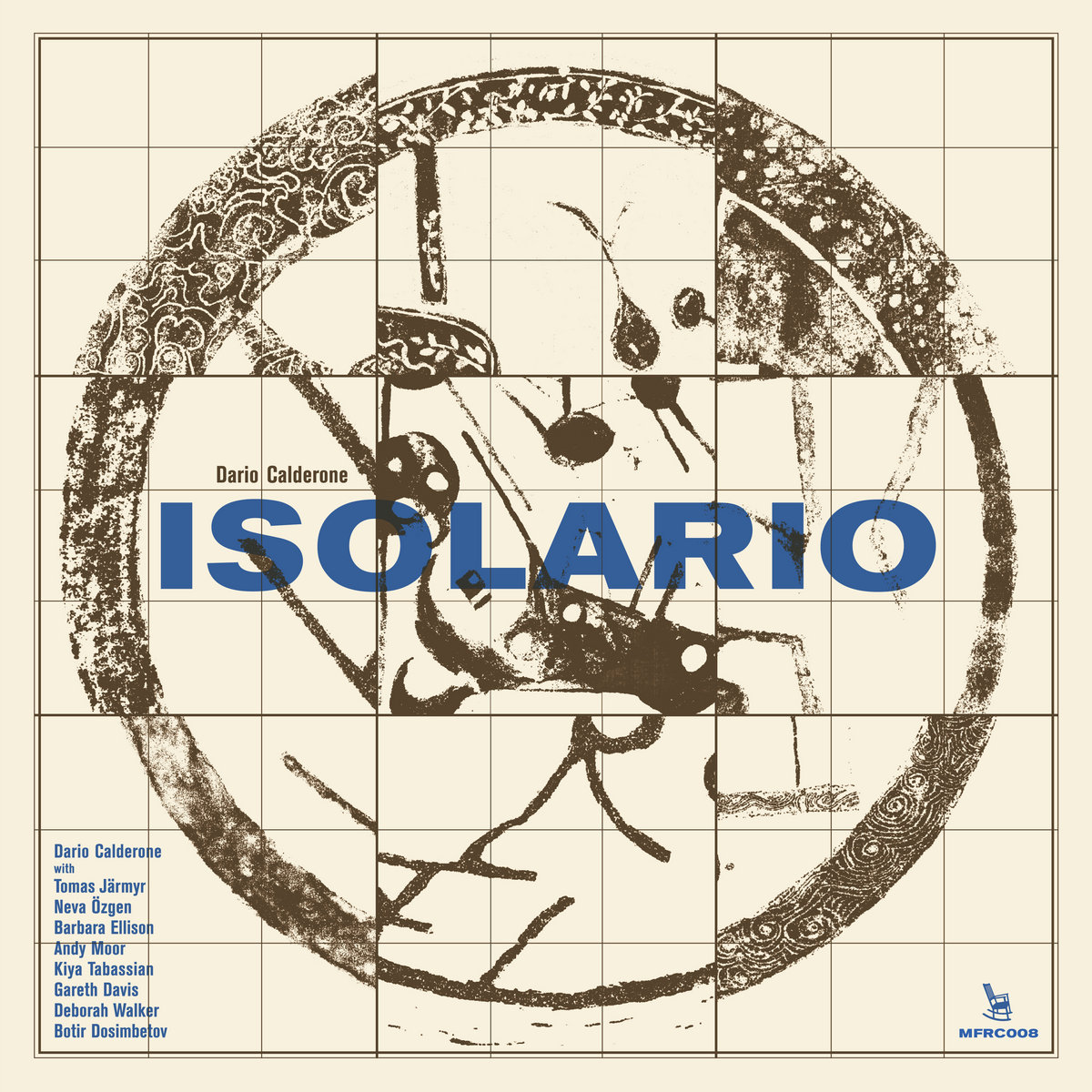
Isolario
Dario Calderone
- Sindarūsa
- Isola Di Malakān
- Isola del sommerso
- Isola combusta
- Nell’oceano
- Isola mobile
- Isola di Tārān
- Le Tre Isole
cd/dl/stream on Moving Furniture, July 2023
Dario Calderone: double bass, composition
Tomas Järmir: drums (on track 1)
Neva Özgen: kemençe (on track 2)
Barbara Ellison: electronics (on track 3)
Andy Moor: electric guitar (on track 4)
Kiya Tabassian: setar (on track 5)
Gareth Davis: bass clarinet and electronics (on track 6)
Deborah Walker: cello (on track 7)
Batir Dosimbetov: nay and electronics (on track 8)
Isolario is a cycle of 9 duets, which can be performed, or just imagined, by any instrument or voice. The inspiration of these compositions comes from a compilation of texts by medieval writers from the “Arabic” world, describing a special and wonder-full island.
Beyond the fact that these islands really exist, what interests me is the description of the extraordinary, and how the “magical thinking” has shaped the imagination of the medieval navigators, creating recurrent spaces which survived until our contemporary culture. I chose texts that described a behaviour, or a sociological attitude, that could be transposed into a musical context. The scores consist in a textual part and in a visual part; the music resides in the clash between these 2 sorts of material.
The visual part of the scores consist of my versions of pre-existing maps from the medieval Arab and Persian tradition of KMMS. The use of these non-mimetic maps, was certainly not for navigation, as in the case of the modern ones, but they had an iconographic use: they could be defined as carto-ideographs. Therefore, these pictures can be seen not as descriptions of territories but rather as spaces, in a very similar way as graphic scores do not necessarily describe the final auditive result. My versions of these maps insert in the tradition of inexact copies of copies; nevertheless, they have been bonded to my musical necessities, and therefore transformed into musical graphic scores.
Dario Calderone has been supported for these compositions by the Fonds Podiumkunsten, the Amsterdam Fonds voor de Kunsten, and SENA.
For more information, and to see the full score, please visit dariocalderone.com/compositions
Reviews
anothergreenkitchen
Taking speculative maps drawn in the 10th century by geographer and writer Abu Ishaq Ibrahim ibn Muhammad al-Farisi al-Istakhri and using them as graphical notation scores, double bassist and sound artist Dario Calderone has assembled on his latest album, Isolario, available on Moving Furniture Records, a cycle of duets that offers multiple worlds of mood, mystery, and virtuosic technique.
First: about those maps. Roughly interpretive, they were made not for accuracy so much as to serve as aids for travelers moving along certain Iranian postal routes. Fittingly, it’s the very loose, speculative nature of the maps – images both vague and specific in their abstract, dreamlike appearance – that Calderone draws on to suggest pathways to his fellow musicians as they create their music. (Calderone re-drew the maps himself for use in his project and includes them in a pamphlet available for download on the Bandcamp page. Like the originals they are derived from, they both charm and fascinate.)
As for the music, it charms and fascinates as well. “Sindarūsa,” a duet with drummer Tomas Järmir, is a carefully calibrated blend of Calderone’s steady strokes buttressing Järmir’s slowly building rolls, bursts, and cymbal splashes as they delicately unfold across his kit. “Isola di Malakān,” featuring Neva Özgen on the kemençe, a small, pear-shaped, three-stringed instrument, is a mournful mélange of textures and sighs with Calderone’s electrified double bass providing metallic swells and gusts to Özgen’s passionate flights and occasional frenzied strums. Andy Moor’s unconventional approach to guitar playing yields an array of noise on “Isola Combusta,” from waterlogged, bent notes to off-tune twangs to haunted, bell-like chimes, all of which seem to call forth a parched, keening, upper register response from Calderone that casts the whole thing into a bleak, quasi-Morricone landscape.
“Nell’oceano” finds setar master Kiya Tabassian in perfect sync with Calderone, who plays his double bass at times like a tuned drum while also sparking off some lovely harmonics to Tabassian’s focused, insistent melody. It’s a beauty. On the follow-up track, “Isola Mobile,” Gareth Davis on “bass clarinet and electronics” incinerates that beauty down to the bone as he and Calderone trade and combine some of the harshest, most prickly textures they can wring from their instruments. “Isola Di Tārān,” featuring Deborah Walker on cello, initially continues that abstracted interplay, but as the track proceeds it transforms itself into a conversation of corrugated growls, glinting overtones, and shuddering groans. There’s something both playful and mysterious at work in the racket she and Calderone kick up.
The album closes with “Le Tre Isole,” and Batir Dosimbetov accompanying Calderone on nay, an Uzbekistani wooden flute. Dosimbetov’s whispery textures and shivery blasts clear open expanses throughout the track, creating an ethereal atmosphere, but Calderone’s spare, hotwire drones – and the subtle inclusion of field-recorded conversations – keep things grounded. It’s the emptiest-feeling track here, and before you know it, it’s done and gone. But Isolario is the kind of album that you want to go back and listen to, just to see what you missed. It’s also the kind of album that yields more with each listen.
Silence And Sound
Isolario est une oeuvre étonnante, puisant son inspiration dans des textes médiévaux du monde arabe, décrivant des iles merveilleuses mais bien réelles.
Pour mettre en musique ces descriptions d’un autre âge, Dario Calderone s’est entouré de musiciens venus d’univers divers et variés, avec lesquels il a composé 8 titres en duo.
Via chaque proposition musicale, notre imagination se met en action, tentant de mettre en images ces visions voyageuses surgies d’un espace, où le temps sert de liaison.
Les univers se confondent et laissent exploser leur faune et leur flore éclatantes, vestiges traversant les âges pour arriver jusqu’à nous et prendre à leur tour, des formes subjectives qui nous seront intrinsèques.
On est frappé par la diversité et la beauté de chaque composition, formant tous un carnet de voyage, où les lumières flottent à travers des nuages tourmentés ou dansants, donnant vie à des bouts de terre chargés de souvenirs et de ressentis, d’émotions et de fragrances, échappées tournoyantes au dessus de mers toumentées ou apaisées. Très fortement recommandé.